
Slab Leak Repair Options: Spot Repair vs Reroute vs Repipe vs Epoxy Lining
Compare the four slab leak repair options, honest Arizona cost ranges, and a simple rule for choosing between spot repair, reroute, repipe, and epoxy lining.
The short answer: a single leak in sound pipe is usually a spot repair; a second leak, an unreachable location, or aging copper points to a reroute; three or more leaks or polybutylene pipe calls for a whole-house repipe; drain lines, not supply lines, are where epoxy lining earns its keep. The rest of this guide shows you how to tell which situation you are in.
A slab leak puts you in an uncomfortable position: water running where it should not be, a concrete floor between you and the pipe, and a contractor telling you that you need a repair you do not fully understand. Most homeowners here search the same question: should I repair, reroute, or repipe? Our slab leak repair guide covers the basics of each choice; this article is the decision framework on top of it. There is no single right answer, and any contractor who gives you one before testing your system should worry you. The four options below solve different problems, and every one of them starts with a precise diagnosis.
What does a spot repair actually involve?
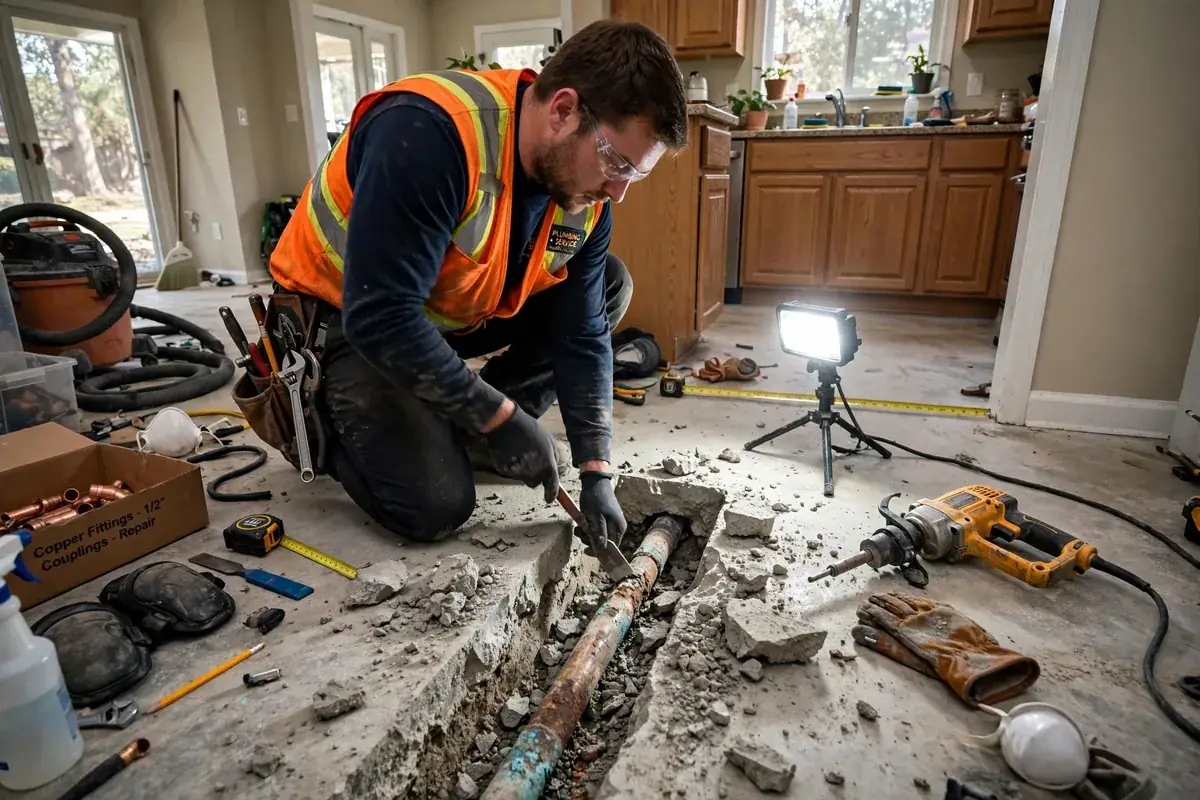
A spot repair is the most direct fix. The leak is located precisely, the flooring over it is lifted, and the concrete is opened with a jackhammer, usually a square about two to three feet across. The technician exposes the copper line, cuts out the failed section, solders or presses in a new piece of pipe, pressure tests the repair, backfills with sand or gravel, and pours a concrete patch. The job itself is often done in a day.
What surprises most homeowners is what happens after the concrete cures. The flooring restoration is a separate trade. A concrete patch is gray concrete; making tile, wood, or carpet look like nothing ever happened takes a flooring contractor, and the result depends entirely on what flooring you had. Under carpet or floating laminate, a spot repair can be nearly invisible when the flooring goes back down. Under discontinued tile, the patch is honest but visible.
In Arizona, spot repairs are typically seen in the range of $500 to $2,500, depending on how deep the line sits, how much concrete has to come out, and whether tunneling is needed instead of breaking straight through. Quotes vary by access, flooring, and local rates, so treat any number you see online, including this one, as a starting point for a real estimate, not a promise.
A spot repair is the right answer when the leak is a loner: one leak, in pipe that is otherwise in good shape, in a location you can open without destroying an irreplaceable floor. It is the wrong answer when the pipe is failing as a system. A pinhole in thirty-year-old copper that has been drinking Phoenix-area hard water its whole life is rarely the last pinhole. Fix the section, and have a plumber assess the remaining lines.
What does a slab leak reroute involve?
A reroute abandons the leaking line where it sits and runs a new one around the slab, usually through the attic, through wall cavities, or along the exterior. The old line is capped at both ends and left in the concrete, dead. The new line is almost always PEX these days: flexible, corrosion-proof, and able to snake through framing with far fewer joints than copper.
Homeowners like reroutes for one reason above all: nobody opens your floor. The tradeoff moves elsewhere. The crew opens drywall at a few points to feed the new line, so you trade concrete dust for drywall patches and a paint touch-up. For most people that is a better trade, because drywall is cheap and forgiving while slab openings are neither.
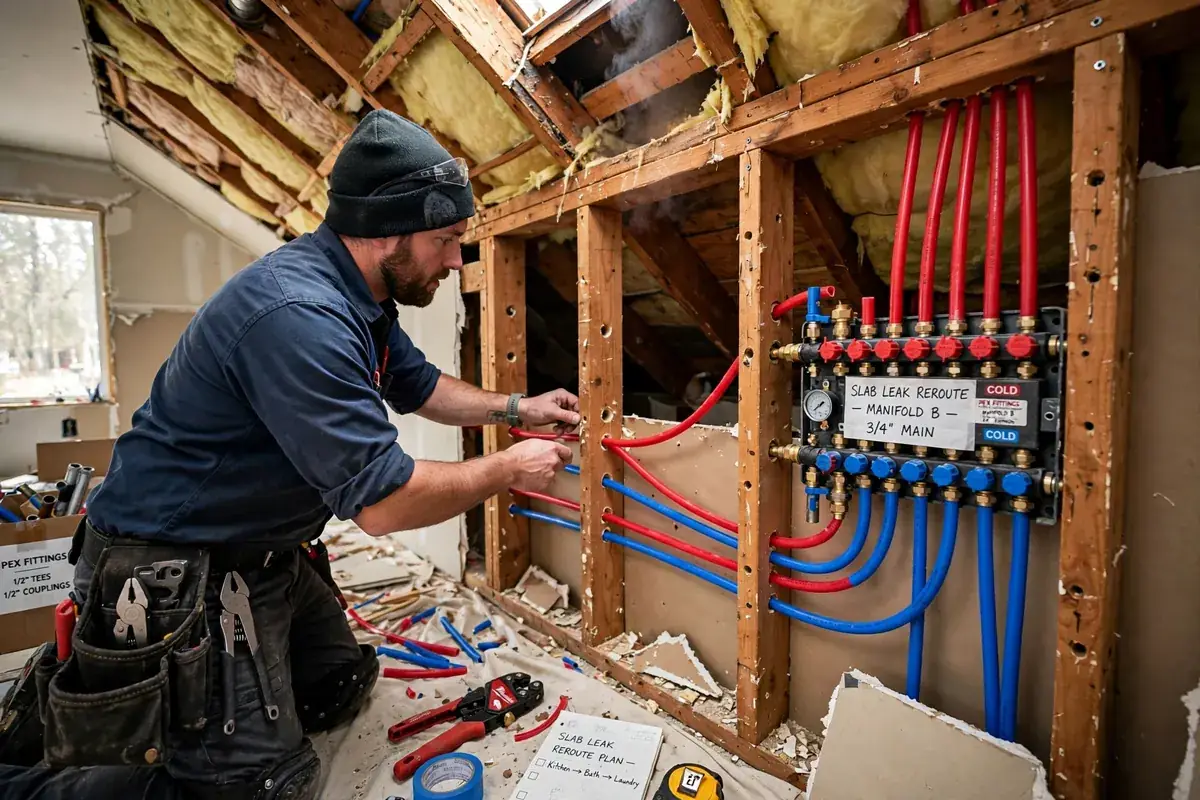
A reroute of one or two lines is typically seen in the range of $1,500 to $4,000 in Arizona, and the job usually wraps in one to two days. It is the right answer in four situations: the leak sits under flooring you cannot patch invisibly; the same line has leaked before; the home has a post-tension slab you do not want to cut; or the leak is on a hot-water line, which deserves a longer look because hot-water slab leaks tend to repeat. Hot copper fails faster than cold copper, so when the first hot-line leak appears in an older home, rerouting the whole hot run is often cheaper than fixing leaks one jackhammer at a time.
The main limitation of a reroute is that it only replaces the lines you reroute. If the leak is on a cold line but the hot lines are the same age and material, you have solved this year's problem while next year's waits in the same slab. A good contractor tells you that up front instead of discovering it at your expense.
When does a whole-house repipe make sense?
A whole-house repipe replaces every hot and cold supply line in the home, abandoning the entire in-slab system and running new pipe, usually PEX, through walls and the attic. It is the biggest option on this list: more openings, more patching, more money. It is also the only option that ends the leak cycle completely.
For a typical single-story Apache Junction home, repipes are typically seen in the range of $4,500 to $12,000, depending on square footage, the number of fixtures, one story versus two, and the material chosen. The plumbing work itself usually takes one to three days; drywall and paint restoration follow. As with every figure in this guide, quotes vary by access, layout, and local rates.
A repipe is the right answer when the system is failing, not just one section of it. The clearest signals: three or more slab leaks, widespread green corrosion or pitting found on exposed copper, or polybutylene supply piping, the gray plastic used in many 1980s and 1990s homes that is known to fail without warning. If you plan to stay in the home for years, a repipe converts an unpredictable drip of repair bills into one known cost, and it is a genuine selling point when the home eventually changes hands.
What a repipe does not do is touch the drain lines. Supply lines and drain lines are separate systems. If your problem is a drain line under the slab, which brings us to the fourth option, a repipe solves nothing.
Does epoxy pipe lining actually work?
Epoxy lining, sometimes sold as pipe lining or cure-in-place pipe, rebuilds the inside of an existing pipe. A technician cleans the pipe interior, usually with a descaling tool or high-pressure water, then coats or blows in a two-part epoxy that cures into a smooth, seamless liner inside the old pipe. The crew works through cleanouts and fixtures, so there is no digging and no jackhammer. Typical projects are typically seen at $80 to $150 per linear foot, which usually lands a full job in the $4,000 to $10,000 range.
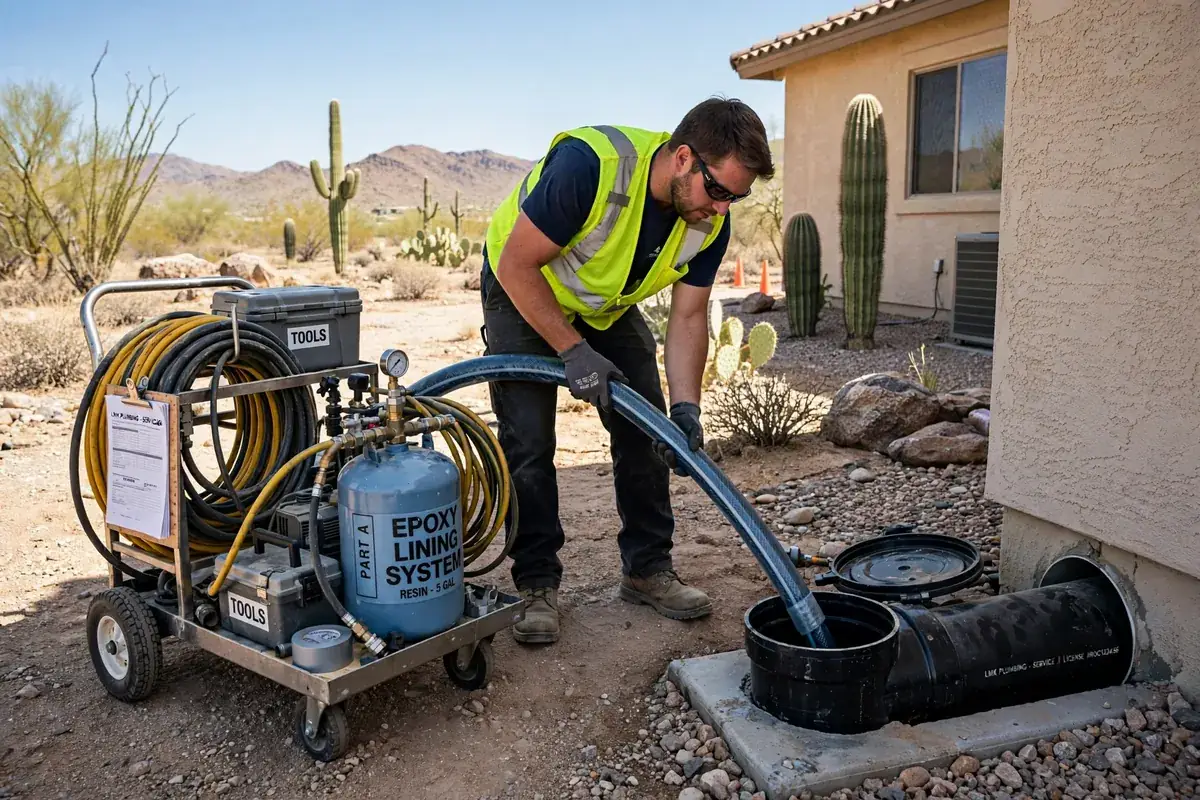
So does it work? Yes, for the job it was built for: drain and sewer lines. When a cast-iron or clay drain under the slab is scaled, rough, or seeping at joints but still structurally sound, a liner gives it a new interior surface without excavation. That is a real win, because digging up a drain line means trenching the slab open along its full length.
Here is the honest boundary that matters for slab leak homeowners: epoxy lining is not the answer for a pressurized copper supply line leaking under a slab. Supply-side slab leaks are pinholes and splits in copper carrying 50 to 80 psi. They need a spot repair, a reroute, or a repipe. A contractor pitching epoxy for your supply-side slab leak is either confused or selling the one tool they own. Epoxy also has its own fine print on drains: the liner is only as good as the cleaning before it, a collapsed or bellied section cannot be lined, and you should ask for the warranty terms in writing before you sign.
How much does each slab leak repair option cost in Arizona?
Costs are the first question everyone asks and the hardest to answer honestly without seeing the home, because access and flooring move every number. The ranges below are what Arizona homeowners typically see, gathered from contractor estimates and industry pricing, not quotes for your house. Our slab leak cost guide goes deeper on what pushes each number up or down.
| Method | What it disrupts | Typically seen cost | Best when |
|---|---|---|---|
| Spot repair | Concrete opening at the leak, then flooring restoration | $500 - $2,500 (more with tunneling) | One leak in sound pipe, under flooring that is easy to patch |
| Reroute | Drywall openings for the new run; no slab cutting | $1,500 - $4,000 for one or two lines | Second leak, unmatchable flooring, post-tension slab, aging hot line |
| Whole-house repipe | Wall and ceiling openings at fixture points; full drywall and paint restoration | $4,500 - $12,000 depending on size and material | Three or more leaks, polybutylene pipe, systemic pinhole corrosion |
| Epoxy lining | Minimal: access through cleanouts and fixtures | $80 - $150 per linear foot (typical projects $4,000 - $10,000) | Drain or sewer lines that are rough or seeping but structurally sound |
Two notes on reading this table. First, the ranges overlap on purpose: a difficult spot repair with tunneling can cost as much as a simple reroute, which is exactly why a fixed quote for your home beats any table. Second, every option leaves a restoration bill: concrete, flooring, drywall, and paint. Ask whether the quote includes restoration or just the plumbing, because that difference has surprised more homeowners than any line item in the industry.
The floor problem: tile and terrazzo change the math
In Arizona, the floor votes. So many Apache Junction homes have tile, and so many older ones have terrazzo, that the flooring often decides the repair method before the pipe does.
Tile is the quiet budget-killer. A box of your exact tile from fifteen years ago does not exist anymore, and tile lots vary in shade even when the pattern matches. A patched square of slightly-off tile in the middle of a living room reads as a repair forever. Terrazzo is worse: the poured stone-and-cement floors in mid-century Arizona homes essentially cannot be patched invisibly at any price, and grinding a patch to blend usually makes it more visible, not less.
This is why reroutes are so popular in Arizona. The moment the floor becomes the expensive problem, abandoning the under-slab line and running a new one overhead stops being the cautious option and starts being the cheap one. Carpet and floating laminate are the opposite case: the flooring lifts and goes back down, and a spot repair through the slab is straightforward. If your home has an original terrazzo floor, get bids from contractors who do reroutes before you let anyone near your slab with a jackhammer.
The three-leak rule of thumb
Plumbers have a rule of thumb for slab leaks, and it is worth knowing because it reframes the whole decision. The first leak is an event. The second leak is a warning. The third leak is a pattern.
By the third leak, you are no longer fixing a pipe; you are subscribing to a problem. Each repair costs roughly what the last one cost, the damage an unrepaired leak can cause compounds between visits, and you are paying retail for the same emergency three times instead of wholesale once. At that point, a repipe, or at minimum a full reroute of the failing system, is usually cheaper than repairs four and five.
The rule has one exception: leaks caused by a single identifiable cause, like a kinked line from the original construction or one bad solder joint. A plumber can usually tell the difference between a localized defect and systemic corrosion by looking at the failed section. Ask to see the removed pipe. Pitting and green crust along the whole piece means the system is going; one clean failure at a fitting means the rest of the pipe may be fine.
A warning about post-tension slabs
Many Arizona homes built from the 1990s onward sit on post-tension slabs: concrete threaded with steel cables that were stretched tight after the pour, like a bowstring, to keep the slab from cracking as the soil moves. These slabs usually have a stamp or a small warning plate near the garage, and they change the repair conversation completely.
Cutting into a post-tension slab without locating the cables first is dangerous. A severed tension cable can whip out of the concrete with enough force to cause serious injury, and cutting several of them compromises the slab the house depends on. A spot repair on a post-tension slab is still possible, but only after the cables are located, usually with ground-penetrating radar, and the opening is planned around them. Many homeowners with post-tension slabs choose a reroute specifically to avoid cutting the slab at all.
If a contractor reaches for a jackhammer on your post-tension slab without mentioning cable location, that is your sign to get a second opinion. Any reputable contractor working in newer Arizona subdivisions treats post-tension cable location as a mandatory first step, not an upsell.
Detection first: the repair is only as good as the diagnosis
Every option in this guide depends on two facts you cannot guess: exactly where the leak is, and whether it is the only one. A spot repair at the wrong spot is an expensive hole. A reroute that misses a second leak buys you a few months. A repipe chosen when one repair would have done is money spent on fear.
That is why the work starts with leak detection services, not a repair crew. Pressure testing each line separately tells you which line is failing. Electronic and acoustic listening pinpoints the leak, often within inches, through the concrete. If you are still in the noticing stage, our guide to slab leak symptoms helps you confirm what you are dealing with before you spend anything.
When you call, ask the contractor three questions: how will you confirm the exact location before opening anything, what condition is the rest of the pipe in, and why does the option you are recommending fit my home and not just your schedule. The answers tell you more about the contractor than the quote does. For more on choosing a contractor and what to expect, see our slab leak FAQ.